
I Tracked 500+ Potty Breaks — Here's What I Learned About Puppy Potty Training
Real data from tracking every potty break during my Golden Retriever puppy's first months. Week-by-week guide with actual patterns and insights.
Jaap Stronks
I Tracked 500+ Potty Breaks — Here’s What I Learned About Puppy Potty Training
Quick answer: Potty training a puppy takes 2-4 weeks of consistent effort. The secret isn’t a magic technique — it’s timing. Take your puppy out after every nap, every meal, and every play session. That’s it. The hard part is actually doing it 15+ times a day.
The Day I Became a Human Potty Alarm
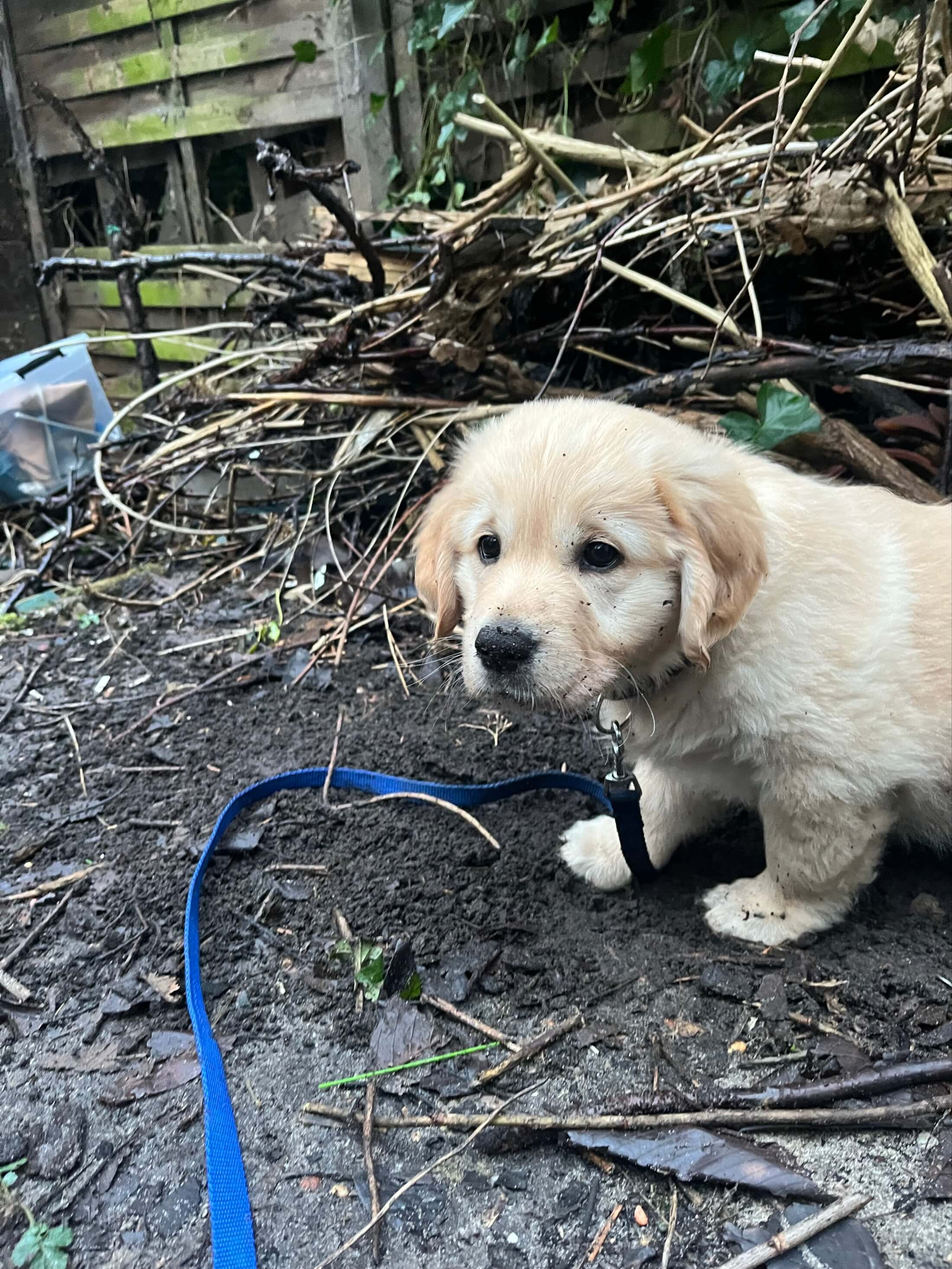
On February 14th, 2026, I picked up Ollie — an 8-week-old Golden Retriever — from the breeder. He sat on my lap during the car ride home, completely zen. I thought: This is going to be easy.
Five hours later, I’d cleaned up four puddles and one… other thing. Welcome to puppy parenthood.
Over the next two and a half weeks, I tracked every single potty break. Every pee, every poop, inside and outside. The location, the time, what happened right before. I became, essentially, a data analyst for a creature who eats shoes.
Here’s what 169 tracked potty events (and counting) taught me about puppy potty training — and why tracking changed everything.
The Raw Numbers: My First 17 Days
Let me share something most puppy training guides won’t: the real data.
Day 1 (pickup day): 5 accidents inside, 0 outside. That’s a 0% success rate, folks.
Day 2: 3 inside, 7 outside. Already better! But those 3 indoor accidents? All happened when I got distracted or didn’t move fast enough.
Day 3: 4 inside, 8 outside. Progress isn’t linear.
Day 4: 1 inside, 7 outside. Something clicked — both for Ollie and for me.
Week 2 average: About 2-3 accidents per day, trending down.
Day 14 (Feb 27): 0 inside, 8 outside. Zero accidents for the first time!
Day 15 (Feb 28): 0 inside, 7 outside. Two perfect days in a row!
By the end of two weeks, my inside/outside ratio went from 100% accidents to roughly 90% success. Not because Ollie suddenly “got it” — but because I learned to read him.
The Puppy Potty Training Schedule That Actually Works
After tracking all this data, a clear pattern emerged. Here’s the schedule that worked for us:
The Non-Negotiable Times (Take Your Puppy Out EVERY Time)
- Immediately after waking up — even from a 20-minute nap
- Within 10 minutes after eating
- After any play session or excitement
- Every 1-2 hours during awake time (for an 8-week-old)
- Last thing before crate/bedtime
Our Actual Daily Schedule at 8-9 Weeks
- 5:00-6:00 AM — Wake up → straight outside
- After breakfast → outside within 10 min
- Every wake-up from naps → outside immediately
- After every meal (3-4 meals/day) → outside
- Every 1.5 hours during awake periods → outside
- 10:00-11:00 PM — Last potty break → crate for the night
- ~4:00-5:00 AM — Middle-of-night break (yes, really)
That’s roughly 12-15 outdoor trips per day. It’s exhausting. It’s also the entire secret.
The Schedule at 10-11 Weeks
By week 3, things shifted:
- Wake-up time moved to ~6:00 AM (no more 4 AM breaks — hallelujah)
- Awake intervals stretched to 2-2.5 hours
- Down to 8-10 outdoor trips per day
- Night-time accidents: zero
The 5 Patterns I Discovered by Tracking
Pattern 1: The “Post-Nap Pee” Is Real — And Urgent
Here’s something I didn’t read in any book: puppies need to pee immediately after waking up. Not “in a few minutes.” Not “after I finish this email.” Now.
In my data, roughly 80% of indoor accidents happened within 5 minutes of Ollie waking from a nap. The ones I caught? I had him outside within 60 seconds of seeing his eyes open.
The lesson: When that puppy stirs, you move. Shoes by the door. Leash ready. Sprint mode.
Pattern 2: Accidents Cluster Around Disruptions
On Day 5, Ollie had his first vet visit. The disruption to his routine resulted in 5 accidents that day — the worst since Day 1. Visitors, schedule changes, new environments — anything that breaks the pattern causes regression.
I saw the same thing on days with visitors: the excitement plus broken routine equals puddles.
The lesson: On disrupted days, increase your outdoor trips. Over-correct, don’t under-correct.
Pattern 3: The “Fake Garden Visit”
This one drove me crazy. I’d take Ollie to the garden. He’d sniff around, lie down, look adorable. Come back inside. Pee on the kitchen floor within 2 minutes.
It happened so often it became a data point. I started logging “garden visit, didn’t pee” as its own category. On Day 3 alone, I had 4 of these false alarms.
The lesson: If they don’t go within 5 minutes outside, come back in and go out again in 10 minutes. Or — use the crate. A short crate session (10-15 min) after a failed outdoor attempt resets the bladder pressure. Then try again. This “crate reset” strategy was a game-changer for us.
Pattern 4: Evening Is the Danger Zone
Looking at my data, the 6-10 PM window had the most indoor accidents. Why? Puppies are overtired by evening. They’re less able to hold it, more likely to get distracted, and you’re more likely to be cooking dinner instead of watching them.
The lesson: Shorten the intervals in the evening. If you’re doing every 2 hours during the day, go to every hour from 6 PM onwards.
Pattern 5: Progress Comes in Steps, Not Slopes
Our accident count didn’t steadily decrease. It went: 5, 3, 4, 1, 5, 4, 3, 1, 3, 4, 2, 1, 4, 0, 0, 2, 0. See that? Big spikes on Day 5 (vet visit) and Day 10 (excited Sunday with the kids). Then suddenly, Day 14 and 15: zero.
Potty training isn’t a smooth curve. It’s a staircase with some steps going backwards. The data made that clear — and stopped me from panicking on bad days.
Week-by-Week: What to Expect
Week 1 (8 Weeks Old): Survival Mode
What’s happening: Your puppy has zero bladder control. They literally cannot hold it. They’re also adjusting to a completely new environment.
Expect: 3-5 accidents per day. More on Day 1.
Your job:
- Take them out every hour during awake time
- Celebrate every outdoor pee like they won the Nobel Prize
- Clean indoor accidents with enzyme cleaner (no ammonia!)
- Don’t punish — they don’t understand yet
My experience: Day 1 was rough. By Day 4, I was getting the hang of reading Ollie’s signals. He started doing a subtle sniff-and-circle before peeing. Once I learned to spot that, accidents dropped immediately.
Week 2 (9 Weeks Old): Pattern Recognition
What’s happening: Your puppy is developing preferences and tiny habits. Bladder capacity is slightly increasing.
Expect: 1-3 accidents per day. Some perfect days mixed in.
Your job:
- Start extending intervals to 1.5-2 hours
- Watch for their personal “I need to go” signal
- Keep the routine rock-solid
- Start associating a word (“go potty,” “do your business”) with the act
My experience: This is when tracking paid off massively. I could see that Ollie consistently peed about 15-20 minutes after eating and within 2 minutes of waking up. Knowing his personal pattern turned me from reactive to proactive.
Week 3 (10 Weeks Old): Building Reliability
What’s happening: Your puppy is starting to “get it.” They may start going to the door or showing clearer signals.
Expect: 0-2 accidents per day. Accidents are now the exception.
Your job:
- Extend intervals to 2-2.5 hours
- Start trusting (but verifying) their signals
- Handle regression days calmly
- Begin giving slightly more indoor freedom
My experience: We had our first zero-accident days! But also a regression when the routine changed. The data kept me sane: I could look at the trend line and see real progress despite the occasional bad day.
Week 4+ (11+ Weeks): Consolidation
What’s happening: Muscle memory for both of you. The routine feels less intense.
Expect: Mostly accident-free, with occasional slip-ups during excitement or routine changes.
Your job:
- Gradually extend freedom
- Drop the middle-of-night break
- Maintain post-nap and post-meal trips
- Don’t get complacent — one lazy weekend can cause regression
The Things Nobody Tells You
It’s Harder on YOU Than on the Puppy
Potty training is less about teaching your puppy and more about disciplining yourself. Your puppy would figure it out eventually — your job is to prevent bad habits from forming while they do.
The hardest part for me was the midnight alarm. Setting my phone for 4 AM, stumbling outside in February in the Netherlands (it was literally snowing on Day 2), waiting for a tiny Golden to sniff every blade of frozen grass. For weeks.
”Regression” Is Normal
After a glorious Day 14 with zero accidents, Day 16 had 2. I almost lost it. But looking at the data, the trend was clearly downward. Bad days happen. They don’t erase progress.
Your Partner Will Have Different Success Rates
I noticed this in our data: Ollie had more accidents with certain family members. Not because anyone was doing it wrong, but because we each read his signals differently. Getting everyone on the same system helped.
How Tracking Changed Everything
I’ll be honest: I didn’t expect tracking to matter this much. I started logging potty breaks almost as a joke — something to obsess over at 3 AM when I couldn’t sleep anyway.
But seeing the actual data transformed my approach:
- I spotted patterns I would have missed anecdotally
- I could see progress on bad days (the trend, not the moment)
- I figured out Ollie’s personal timing (20 min after meals, immediately after naps)
- I stopped panicking about regression because I had proof things were getting better
- I could adjust the schedule based on real data, not generic advice
This is actually what inspired my work on Otis, a puppy tracking app. Because scrolling through spreadsheets at 4 AM isn’t great UX, but the insight from tracking is genuinely valuable. The idea is simple: log potty breaks, meals, sleep — and let the app find the patterns for you. No spreadsheets required.
Common Mistakes (I Made Them All)
-
Punishing accidents — Never works. Clean it up, move on. Ollie had no idea why I was frustrated on Day 1.
-
Waiting too long after naps — Even 3 minutes too long was enough for an accident. Speed matters.
-
Not using the crate — I resisted the crate at first. Turns out it’s the single best potty training tool. Puppies won’t soil their sleeping space (usually), so a crate creates a natural “hold it” instinct.
-
Giving too much freedom too fast — On Day 10, I let Ollie roam the living room while I cooked. Three accidents in two hours. Back to supervised time.
-
Inconsistent schedule on weekends — Puppies don’t know it’s Saturday. Keep the schedule.
Key Takeaways
- It takes 2-3 weeks to see real reliability, 4+ weeks for consistency
- Track everything — patterns only emerge from data
- The schedule is simple: after every nap, meal, and play session
- Expect 3-5 accidents/day in week 1, trending toward zero by week 3-4
- Night breaks are necessary at 8 weeks (usually for 1-2 weeks)
- Regression is normal — look at the trend, not individual days
- The crate is your friend — use it for resets and overnight
- Evening is the danger zone — shorten intervals from 6 PM onwards
FAQ
How long does puppy potty training take?
Most puppies show significant improvement within 2-3 weeks with consistent effort. Full reliability (rare accidents) typically takes 4-8 weeks. Some puppies take longer — breed, individual temperament, and your consistency all matter.
Should I use puppy pads?
I didn’t, and I’d recommend against them if possible. Pads teach your puppy that peeing inside is acceptable in certain spots, which can be confusing. Go straight to outdoor training if you can. Exception: if you live in a high-rise apartment, pads might be necessary for the first few weeks.
How do I potty train a puppy at night?
At 8 weeks, plan for one middle-of-night break (around 3-4 AM). Use the crate — puppies naturally avoid soiling their sleeping area. Take them straight out, let them do their business, straight back to the crate. No play, no fuss, lights off. By 10-11 weeks, most puppies can hold it through the night (6-7 hours).
What do I do when my puppy has an accident inside?
Clean it up with an enzyme-based cleaner (not ammonia or vinegar). Don’t punish, scold, or rub their nose in it. If you catch them mid-accident, calmly pick them up and take them outside. If you find it after the fact, you’re too late — just clean and resolve to watch more closely.
My puppy was doing great and suddenly started having accidents again. What happened?
Regression is completely normal. It’s usually triggered by a schedule change, new environment, illness, or developmental stage. Go back to basics: shorter intervals, more supervision, re-establish the routine. Check your data — you’ll probably see the overall trend is still positive.
Is there a difference between potty training a male vs female puppy?
Not significantly at the puppy stage. Male puppies may start lifting their leg at 4-6 months, which can create new marking behaviors, but the fundamental potty training approach is the same for both.
Jaap is a puppy parent, tracking nerd, and the creator of Otis — a puppy tracking app born from too many 4 AM potty runs and one very patient Golden Retriever named Ollie.